Conference Information | Gather at Leman · New Power in Insemination, Co‑create Innovative Breeding
10 March 2026



Batch sow production constitutes an important management transformation and an inevitable trend for modern intensive farming, delivering significant long‑term benefits such as improved production efficiency, enhanced biosecurity and balanced output. Nevertheless, the transition from continuous production to batch production may bring temporary declines in production indicators including conception rate and farrowing rate, which discourages some pig farms from pursuing transformation. These challenges can be effectively addressed through scientific batch‑production roll‑out planning, precise hormone‑based technical application and standardized staff operation management. Such measures help pig farms boost production performance and realize smooth transition during transformation, so as to achieve higher economic benefits and reap long‑term dividends brought by batch production.
Specifically, implementing batch production is a systematic project. The key steps and elements for successful implementation mainly include:
Accurate pre‑implementation solution evaluation and design (Elements: herd health and pen housing requirements) Select an appropriate batch mode and formulate a detailed transition plan according to sow herd health status, as well as the quantity of farrowing crates and gestation stalls on‑farm.
Core technology — hormone regulation (Element: efficient and stable hormones) It serves as the technical cornerstone for successful batch production. Hormones are adopted to regulate sows’ reproductive cycles, enabling synchronized estrus, insemination, farrowing and weaning, so as to realize all‑in/all‑out batch production. Efficient and stable hormonal products are critical to achieving synchronized estrus and ovulation in sows.
Strict implementation and data recording (Element: personnel) The timing and dosage of hormone administration must be precisely controlled. Key indicators such as conception rate, farrowing rate and litter size of each batch shall be recorded in detail.
Recently, Weisheng has carried out batch‑production roll‑out at two group‑owned pig farms in Southwest and East China respectively, supporting their transition from continuous to batch production. Leveraging well‑designed pre‑implementation plans and V‑One‑Mate® for synchronized estrus and fixed‑time insemination, the technical team achieved conception rates above 90%. The team resolved unstable production performance including low estrus rate and low conception rate of weaned sows in the initial transition phase, enabling smooth and stable batch‑production transformation for both group farms.
Location: A branch farm of a group in Southwest China
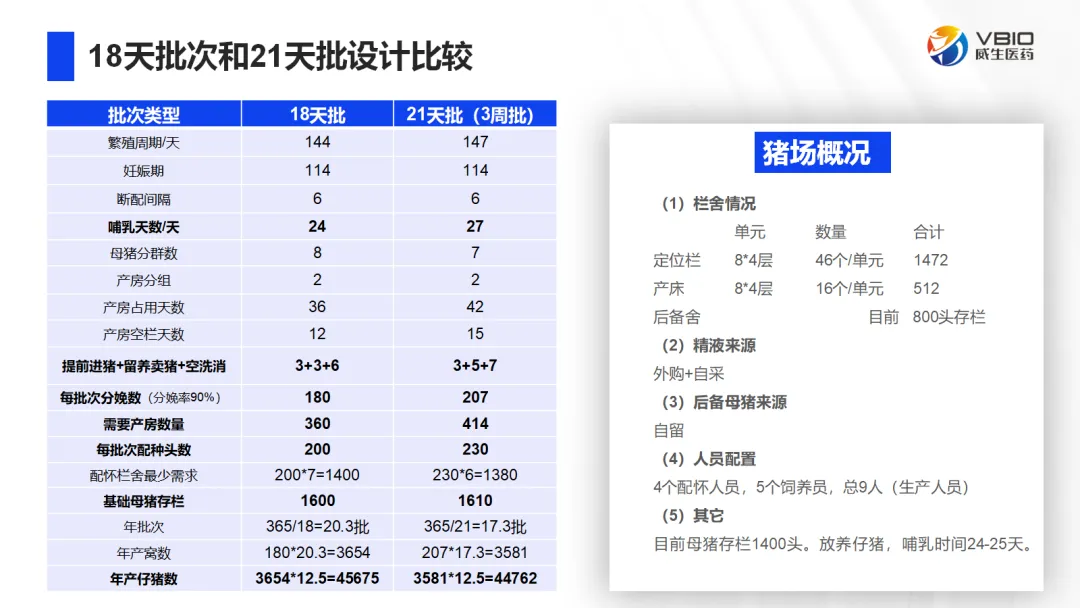
This branch farm keeps approximately 1,600 foundation sows and previously adopted continuous production, mainly raising weaned piglets. Faced with unbalanced production, insufficient capacity and uneven piglet uniformity, the farm decided to implement batch production. This trial aimed to improve sow utilization rate and breeding conception rate via V‑One‑Mate® and minimize losses during production‑mode transition. The implementation plan is as follows:
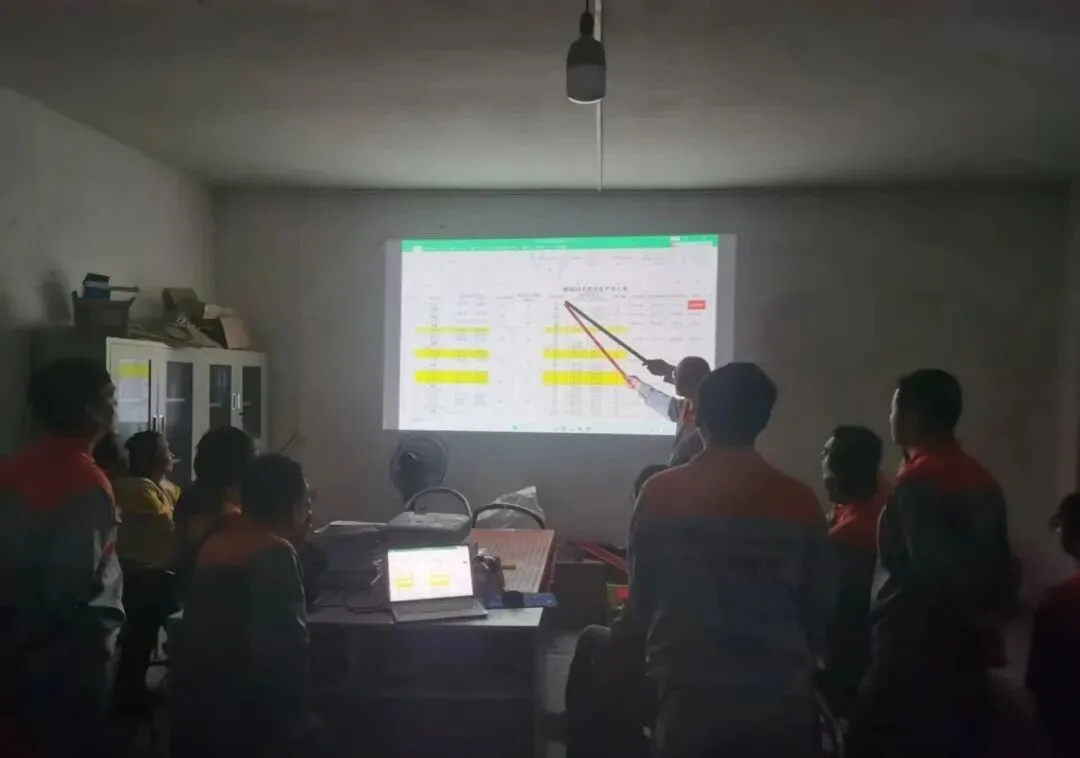
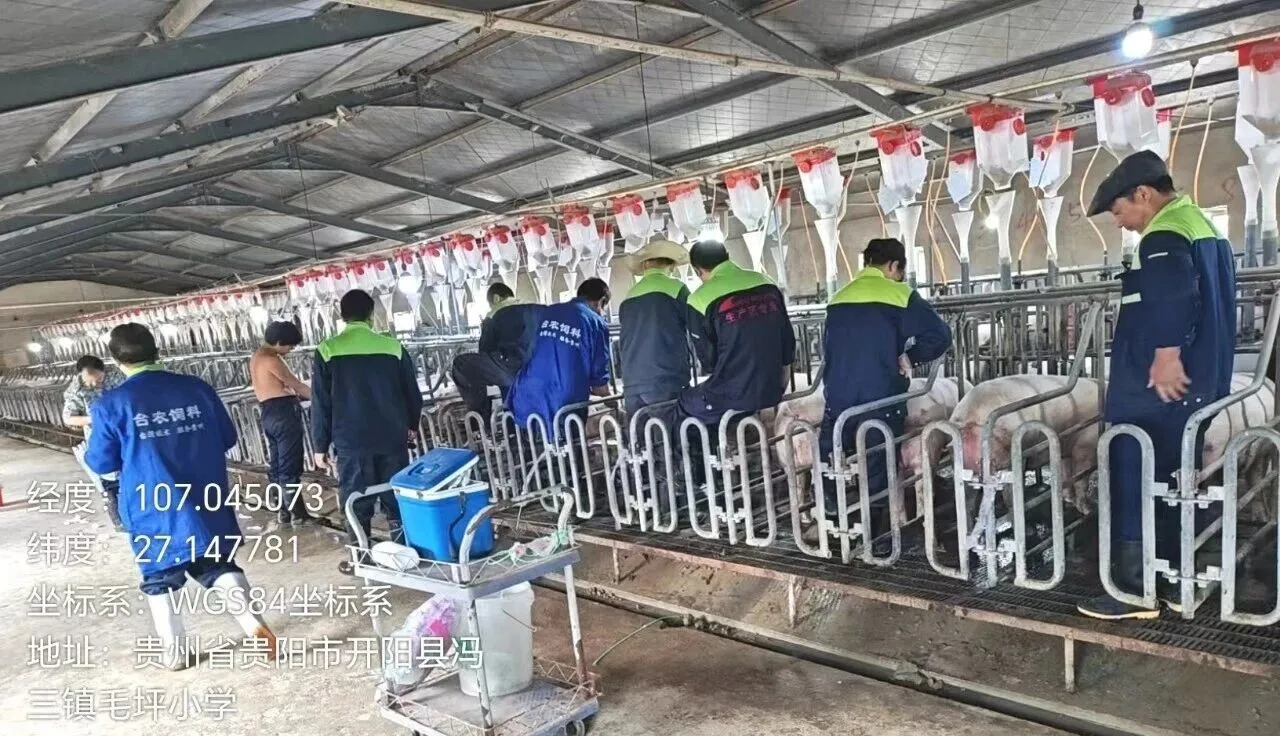
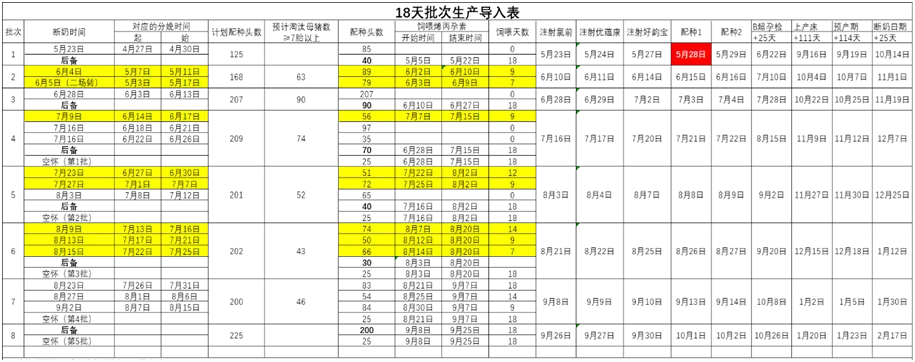
On‑site technical specialists provided on‑farm guidance for smooth roll‑out. A customized solution was developed considering actual conditions including farrowing crate quantity, gestation stall allocation, staffing structure, semen supply and replacement gilt replenishment. After thorough communication, design and comparison between 18‑day and 21‑day batch modes, the 18‑day batch model was finalized with a detailed implementation timeline.
Notes:
(1) Implementation plans and timelines vary across individual farms.
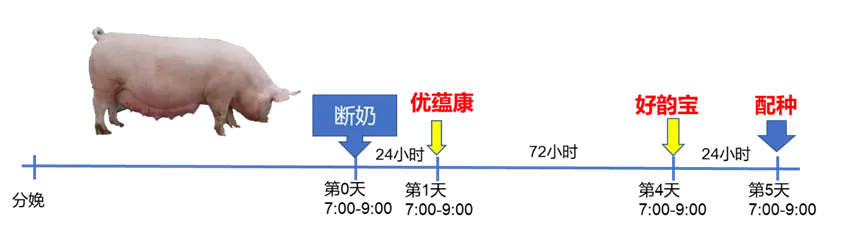
(2) Lactating sows are weaned at normal weaning age. If they fall outside the scheduled mating window, altrenogest feeding shall be initiated prior to weaning and continued post‑weaning until the planned mating time, generally no more than 18 days. Items highlighted in yellow in the table represent farrowing‑house sows requiring altrenogest feeding, usually starting 2‑3 days before weaning.
(3) Gilts and open sows are introduced into the herd with 18‑day altrenogest feeding. Non‑pregnant sows after pregnancy check are generally given one more chance for herd entry.
(4) The red‑marked date May 28th is the first‑batch mating date. Subsequent batches follow an 18‑day mating interval after the first batch is confirmed.
V‑One‑Mate® protocol for multiparous sows
V‑One‑Mate® protocol for gilts / over‑term sows
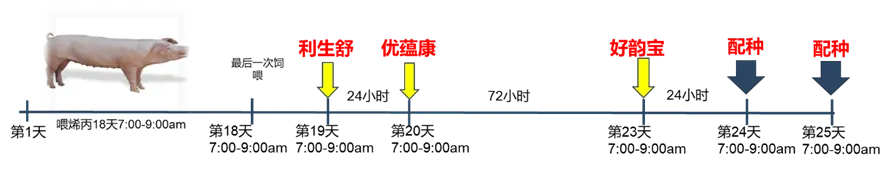
Precautions: (1) For primiparous / multiparous sows showing obvious estrus signs upon the second injection of Haoyunbao under V‑One‑Mate®, perform mating on the same day, followed by group‑wide insemination on the next day. (2) Two matings are recommended for gilts and over‑term sows.
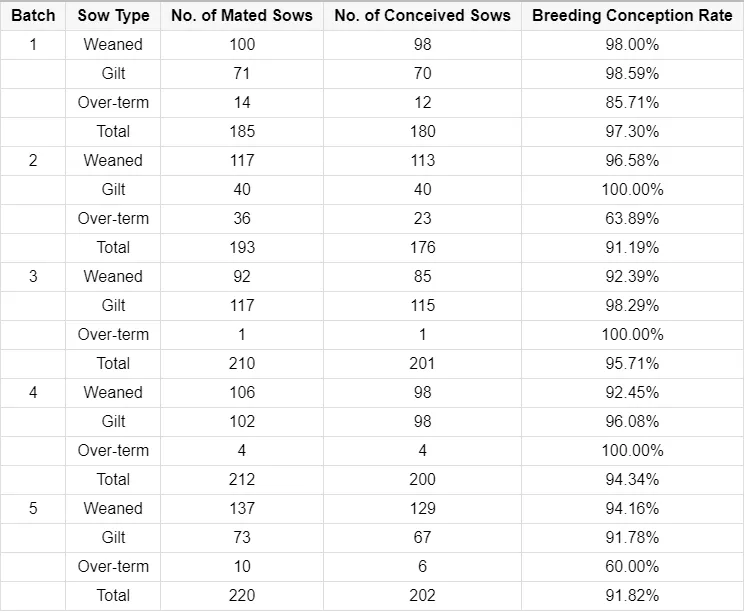
During this 18‑day batch‑production roll‑out, the breeding conception rate remained above 90%. Detailed data are shown in Table 1.
Table 1 Conception rates during 18‑day batch implementation
Location: A branch farm of a group in Central China
This group‑owned pig farm holds 21,000 foundation sows in total, among which the target branch farm keeps around 1,700 foundation sows. Without prior batch‑production practice, the farm suffered volatile production performance. Its ageing facilities discouraged most enterprises from batch‑production adoption. Weisheng delivered a tailor‑made 36‑day batch‑management solution for the farm. This trial adopted V‑One‑Mate® to enhance overall sow utilization and conception rate and achieve stable batch‑production transition. The implementation plan is as follows:
Converted from finishing pig barns, the farm’s farrowing crates are distributed in two zones with abundant farrowing stalls but relatively insufficient gestation stalls. Farrowing stalls in one zone can be repurposed as gestation stalls to meet stall requirements while avoiding failure of all‑in/all‑out caused by geographically separated farrowing houses. After evaluating pen conditions and performance data of 18‑day versus 36‑day batches, the 36‑day batch model was selected to enable all‑in/all‑out operations.
36‑day batch‑implementation table
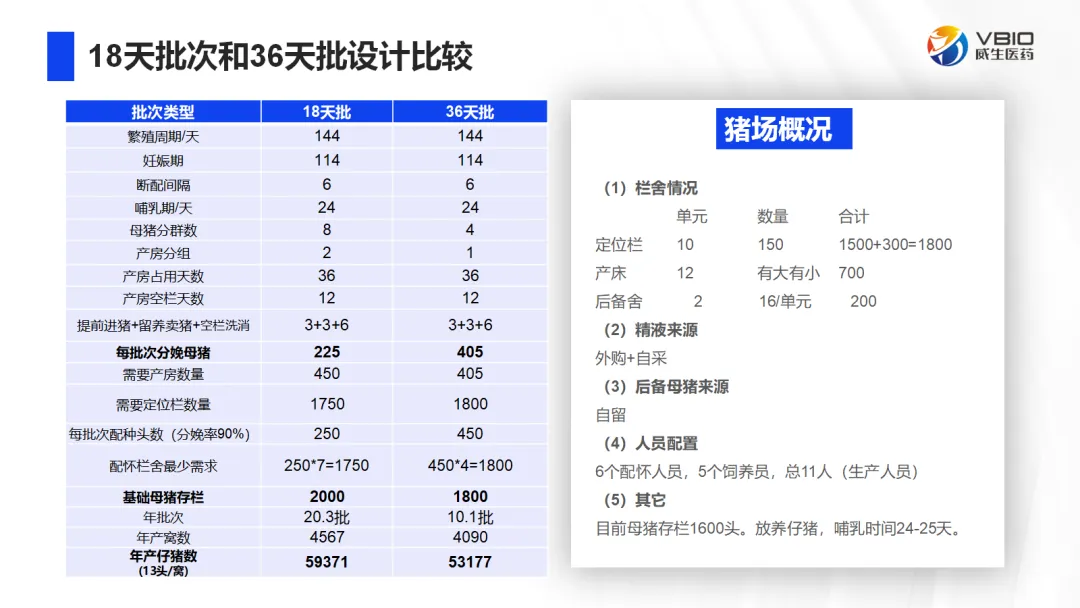
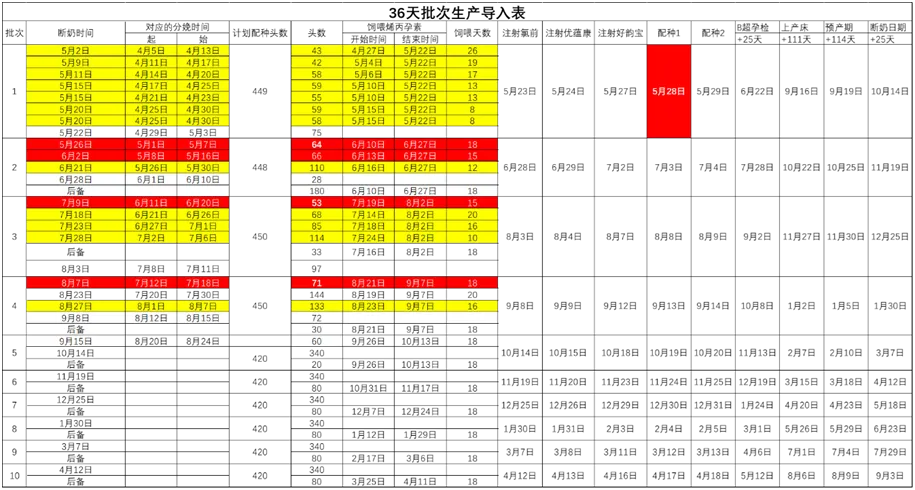
Notes: (1) Yellow‑marked entries in the table represent altrenogest feeding inside farrowing houses; feeding duration shall be adjusted according to field conditions, generally not exceeding 18 days. (2) Red‑marked entries mean sows of this batch shall not be mated post‑weaning. Altrenogest shall be fed as scheduled, and mating shall be performed at the designated time points in the table. (3) May 28th is the first‑batch mating date. Subsequent batches follow a 36‑day mating interval after the first batch is confirmed. (4) Under the 36‑day batch system, all sows across the farm are divided into four groups for cyclic production.
Identical to the V‑One‑Mate® protocol in Case 1.
Two batches have been completed. The estrus rate exceeded 98% and the breeding conception rate was higher than 92%. Detailed performance data are presented in Table 2.
Table 2 Production performance during 36‑day batch implementation
| Batch | Total Head Count | No. of Sows in Estrus | Estrus Rate | No. of Conceived Sows | Mating Conception Rate | Breeding Conception Rate | Number of Healthy Piglets |
|---|---|---|---|---|---|---|---|
| 1 | 410 | 403 | 98.29% | 378 | 93.80% | 92.20% | 14.3 |
| 2 | 420 | 415 | 98.81% | 390 | 93.98% | 92.86% | 14.0 |
Challenges and risks exist during batch‑production roll‑out. Nevertheless, substantial returns including improved management efficiency, biosecurity and economic benefits make batch production an inevitable choice for modern pig farms.
In these group‑farm cases, V‑One‑Mate® offset partial short‑term transition losses by lifting conception rates. It helped farms get through the high‑risk implementation phase and reach stable production faster. Furthermore, its clear execution workflow and strong operability lower technical adoption barriers, suitable for pig farms with varied baseline conditions and management standards.
*V‑One‑Mate® is an innovative domestic one‑time fixed‑time insemination technology independently developed by Guangzhou Weisheng. It supplements FSH (promotes follicle growth and maturation) and HCG (induces ovulation of mature follicles) that directly act on follicles to realize synchronous follicle development and concentrated ovulation. Practical applications in multiple Top30 group pig farms prove that V‑One‑Mate® can significantly improve sow utilization rate, breeding conception rate and litter size, boosting overall farm profitability.